
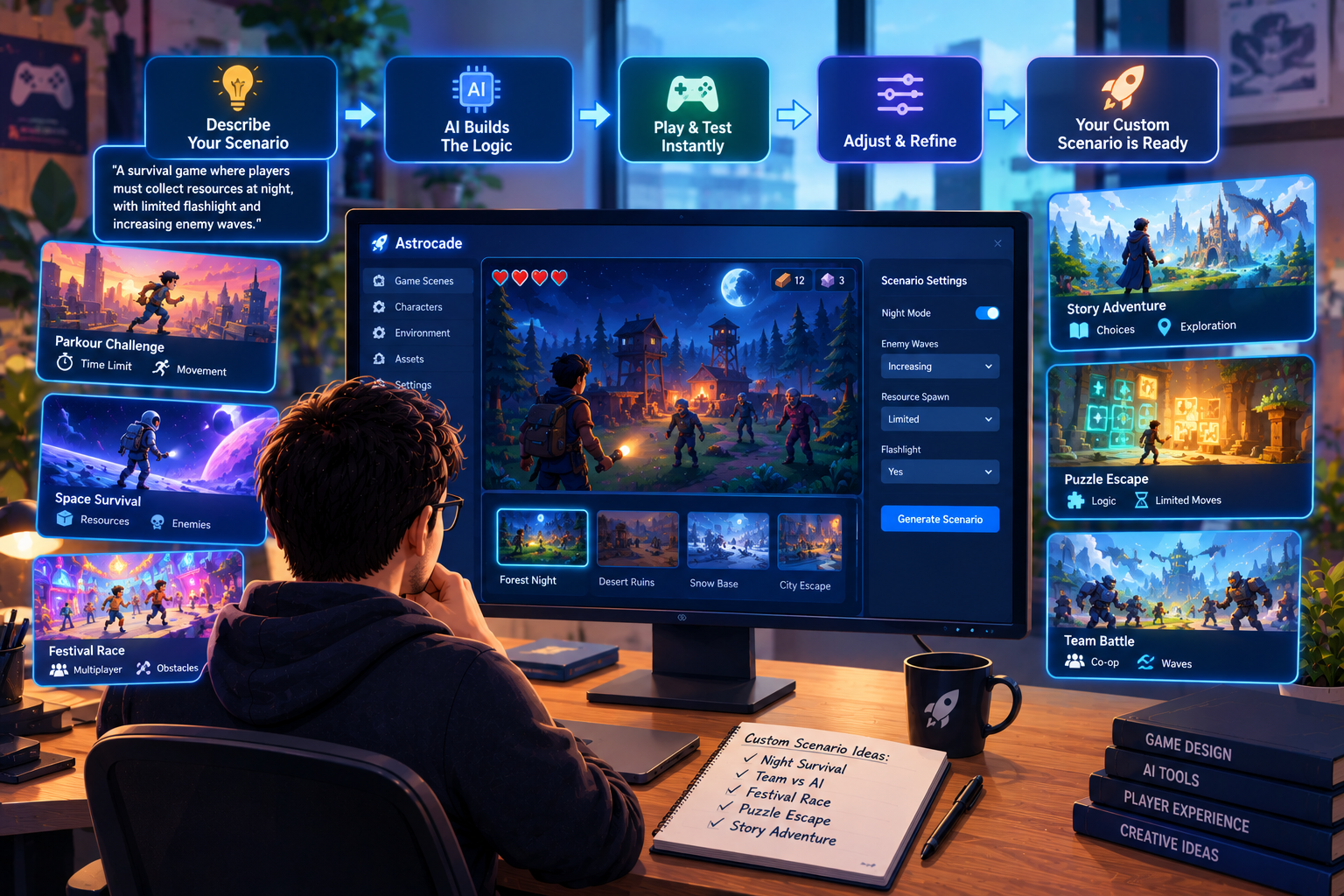
A custom scenario is what turns a generic game system into something that feels specifically designed for a particular moment, audience, or purpose. A standard survival mode is one thing, a survival mode built around a very specific twist that only makes sense for a particular event or community is something else entirely. Building scenarios like that used to require enough technical effort that most creators stuck with generic, reusable setups instead. AI game makers are making custom scenario design realistic even for people without a technical background, opening up a level of creative specificity that used to be reserved for teams with real development resources behind them.
Why Custom Scenarios Matter
Generic Setups Feel Interchangeable
A game built around a completely standard setup, one that could belong to almost any similar game, tends to blend into the background of everything else available. Custom scenarios give a game a specific identity that makes it feel intentional and distinct rather than assembled from default settings.
Specificity Creates Stronger Connection With an Audience
A scenario designed around a particular community, event, or inside reference creates a much stronger sense of relevance for the people it’s built for. Generic content can be enjoyed by anyone, but it rarely creates the same feeling of being made specifically for a particular group.
Why Custom Scenarios Were Historically Hard to Build
Every Twist Required Custom Logic
Traditionally, a unique scenario twist, an unusual win condition, a specific resource constraint, an unconventional map layout, required a developer to manually build and test logic that didn’t exist in a standard template. This meant custom scenarios took real development time proportional to how far they deviated from a familiar setup.
Smaller Creators Defaulted to Generic Templates
Because building something truly custom took real effort, smaller creators and teams without dedicated development resources often settled for more generic, template-based scenarios simply because customizing them further wasn’t realistic within their available time and skill.
How AI Is Making Custom Scenarios More Accessible
Describing a Twist Instead of Building It From Scratch
AI game makers let creators describe an unusual scenario idea in plain language and get a working implementation without manually building the underlying logic themselves. A creator can specify an unconventional win condition or a specific constraint, and the system handles translating that into something functional.
Testing Scenario Variations Quickly
Once a base scenario concept exists, AI-assisted tools make it faster to test variations of it, adjusting difficulty, constraints, or specific rules to see which version actually produces the most engaging experience, rather than committing to the first version that technically works.
Tailoring Scenarios for Specific Audiences or Moments
Because custom scenarios are faster to build with AI assistance, it becomes realistic to create something specifically for a particular audience or occasion, rather than only investing that level of customization into a game’s primary, ongoing experience.
Building Custom Scenarios With a No-Code AI Platform
Having the ability to describe a scenario in plain language only matters if there’s a platform that can turn that description into something playable quickly.
A Platform Designed for This Kind of Creation
Astrocade is a good example of an AI game maker that lets creators build custom scenarios without needing to write the underlying logic themselves. Instead of settling for a generic setup, creators can describe a specific twist or constraint and see it reflected in a playable build.
Seeing a Distinctive Scenario in a Real Game
Crowd Rush is a good example of a game built around a specific, focused scenario rather than a generic setup. Games structured around a clear, particular premise like this tend to feel more distinct and memorable than ones built entirely on interchangeable default systems.
What Still Requires Human Design Judgment
Deciding Which Twists Actually Improve the Experience
AI can help implement a scenario idea quickly, but it can’t decide whether that specific twist genuinely makes the experience more interesting or simply makes it more complicated. That judgment still depends on a designer’s understanding of what the scenario is meant to achieve.
Making Sure Custom Elements Stay Balanced
An unusual constraint or win condition can unintentionally break the balance of an otherwise solid game system. Ensuring a custom scenario remains fair and enjoyable, rather than accidentally broken by its own unique twist, is a design responsibility that AI-assisted tools support but don’t guarantee on their own.
Matching the Scenario to Its Actual Purpose
A scenario built for a specific community or event needs to genuinely reflect what that audience will find meaningful or fun. Understanding the audience well enough to design something that actually resonates with them remains a distinctly human judgment call.
Common Mistakes When Designing Custom Scenarios
Adding Complexity Without a Clear Purpose
Not every custom twist improves a scenario. Adding unusual rules or constraints simply because they’re possible to implement, rather than because they serve a clear purpose, often creates confusion rather than a more compelling experience.
Skipping Playtesting Because the Concept Feels Novel
A scenario that sounds clever in concept doesn’t automatically play well. Custom scenarios in particular benefit from real playtesting, since unusual twists are more likely to have unintended consequences than well-established, thoroughly tested standard setups.
Losing Sight of What Made the Base Game Fun
An overly aggressive custom twist can sometimes undermine the core appeal of the system it’s built on top of. Designers need to make sure a custom scenario still respects what made the underlying game enjoyable in the first place, rather than overriding it entirely.
A Practical Approach to Designing Custom Scenarios
A reasonable process looks like this. Start with a clear sense of what makes the base game fun, and design a custom twist that enhances or reframes that core appeal rather than working against it. Use an AI game maker to describe and test the scenario idea quickly, checking whether it holds up in actual play rather than assuming it works based on the concept alone. Test with real players, paying close attention to whether the custom elements create genuine engagement or simply add confusion, and adjust based on those reactions before finalizing the scenario.
Final Thoughts
Custom game scenarios used to be a luxury reserved for teams with enough development resources to justify the extra effort. AI game makers are changing that by handling much of the technical implementation, which means smaller creators can now build scenarios specifically tailored to a particular audience or moment, without needing the same level of technical investment that kind of specificity used to require.