Prefix-Aware Routing: Using the Start of the Prompt to Pick the Model
The cheapest llm router decision is the one you make before reading the whole prompt: the fixed opening of a request — its system prompt, tool definitions, or instruction block — usually tells you what task you’re running, what it costs, and whether it should hit a cache. We’ve covered how prefix and session-aware routing fit into a production router, and the live rate card for GLM-5.3 shows what a strong mid-tier charges per million tokens once routing steers the easy turns somewhere cheaper; this piece is the plain-English version of when a prompt’s first few hundred tokens are enough to route on, and when you still need to grade the whole thing.
Most explanations of LLM routing describe a grader that scores an entire prompt before choosing a model. That’s accurate, but it’s also the expensive picture. Routing is classification, and classification runs cheaper when the input is smaller. The start of a prompt is a special token stream: for many workloads it barely changes. Prefix-aware routing exploits that stability — it reads the beginning, classifies the task, and lets the body arrive late to a decision that’s already made.
What prefix-aware routing is
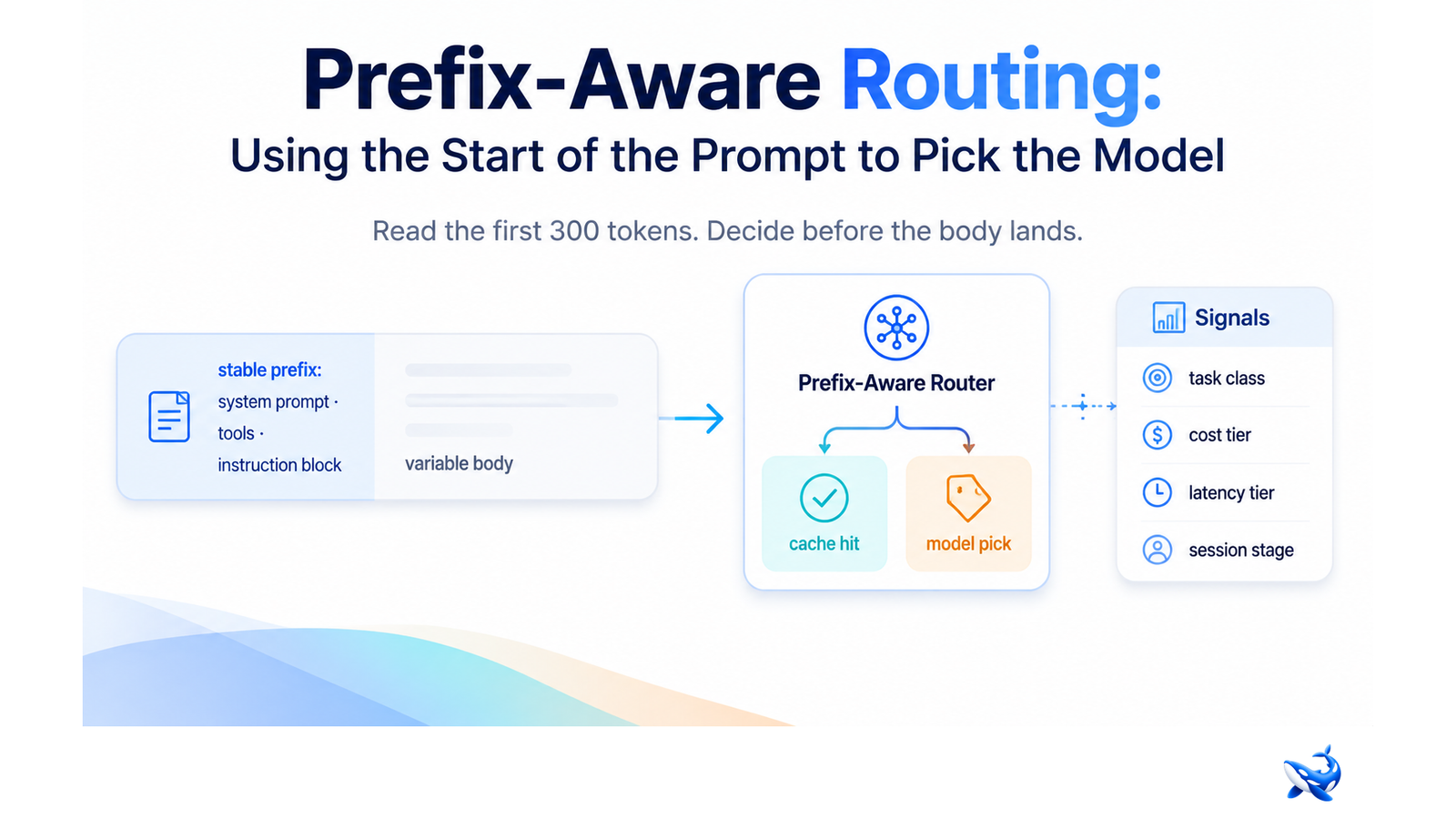
An LLM router sits between your application and every model provider, deciding which model answers each request. Most routers grade the full prompt first. Prefix-aware routing inverts the economics: it keys the decision off the prompt’s fixed prefix rather than the whole payload.
In practice, that prefix is one of three things, or a combination:
• The system prompt. The standing instruction block your application prepends to every request. It changes rarely, so it’s cheap to read and highly predictive of the task.
• Tool definitions. The schema blocks that tell the model what it can call — a prefix listing three tools is a different class of request from one listing thirty.
• A repeated instruction block. The boilerplate your pipeline adds before the variable content — the analysis rubric, the output format, the citation rules.
The router matches that prefix against a table it has already built, then decides which model should answer, which cache tier applies, and whether the request stays on a compact model or escalates to a flagship. The variable body is still passed to the model — it just isn’t needed for the routing decision.
Why the prefix is the cheapest, fastest signal you have
Three properties make a prompt prefix the best raw material a router can work with: it’s small, it’s stable, and it names the task.
• Small means cheap. A system prompt plus tool definitions is a few hundred tokens — a fraction of the cost and time of grading a 20,000-token request, and a decision that can start while the request is still streaming in.
• Stable means cacheable. Identical prefixes are billed as cached input, priced well below standard rates — Anthropic advertises up to 90% off and OpenAI up to 50% off cached-input tokens [VENDOR]. A stable prefix is a cache key waiting to happen.
• Stable means classifiable. Because the prefix barely changes, the router learns it once and reuses the mapping. Every request that opens with the same instruction block is the same task class, so the same routing decision is correct for all of them — no need to re-derive it from the body.
This is the core trade: a prefix tells you what kind of task a request is; the body tells you how hard this instance is. Answering the first question cheaply is often all you need.
How prefix-aware routing works alongside prompt caching
Prefix-aware routing and prompt caching are two views of the same fact: the start of the prompt is the part that repeats. A router that spots a stable prefix can also route it straight into the cache — where the real money is.
The mechanics line up neatly. A provider’s prompt cache matches on exact prefix — send the same system prompt and tool blocks twice, and the second request is billed at the discounted cached-input rate [VENDOR]. The router matches on the same object: same prefix, same task class, same model, same cache entry. When routing is prefix-aware, the request already cached is the one the router recognizes instantly, so the savings compound rather than compete.
The operational side matters too: you want to see, per request, whether the prefix hit the cache and which model it was routed to. That’s what a request log is for — OrcaRouter lists prompt caching and per-request observability among its built-in capabilities, so a routed request leaves an auditable receipt [OURS]. And because OrcaRouter passes provider list prices through at 0% markup, the vendor’s cached-input discount reaches your bill unchanged [OURS].
Prefix-aware vs session-aware routing
The two terms are frequently lumped together, but they read different parts of the conversation.
• Prefix-aware routing reads a single request’s start. It answers the question “what class of task is this?” from the stable opening of the prompt.
• Session-aware routing reads the conversation’s state. It answers “where are we in this exchange?” from accumulated context — turns passed, how deep the task has gone, budget spent — and adjusts the model choice for the next turn [OURS].
They compose. The prefix decides the class of task on turn one; the session decides the stage on every turn after. OrcaRouter implements both — its routing stack is explicitly prefix-aware and session-aware, so a long agent conversation can start on a compact model, escalate to a flagship as it goes deep, and route repeated turns into the cache [OURS].
| Routing mode | What it reads | Best for | Where it’s weak |
| Prefix-aware | The fixed opening of the prompt | Task classification, cache routing, first-turn decisions | Blind to the body and to history |
| Session-aware | Accumulated conversation state | Long agents, multi-turn escalation, budget control | Needs turns before it knows anything |
| Full-prompt grading | The entire request | Hard individual prompts, quality-sensitive routing | More compute per decision |
When the prefix is enough — and when it isn’t
Prefix signals are enough when the variable body doesn’t change the decision — when the task class is fixed by the standing instructions, as with a code-review assistant whose system prompt never changes. For these, the prefix is the whole story, and routing on it costs almost nothing.
Full-prompt grading earns its cost in the opposite case, when the hard part lives in the body. Three situations:
• The body sets the difficulty. A 100-token system prompt in front of a 10,000-token document: the prefix says “analysis,” but only the body says whether that’s a two-line summary or a hard legal review.
• The same prefix carries wildly different requests. A shared system prompt across a whole product makes every request look identical at the front. The prefix names the product, not the task.
• Quality thresholds depend on content. When the quality bar varies by what’s being asked, only the body can tell you.
The practical design is a ladder, not a fork: prefix-first as the fast path, full grading only when the prefix is ambiguous or unknown. That’s the shape OrcaRouter’s adaptive routing takes — it grades every prompt in under a millisecond and routes to the cheapest model that meets your bar [OURS], with the prefix as the cheap gate in front of the fuller check. The savings come from the requests that never needed the expensive read.
The takeaway
Prefix-aware routing fits any workload with a stable instruction block: agents, tools, assistants, pipelines that re-read the same system prompt. It suits you if volume is high, your system prompt is long enough to cache, and you’d like the router to decide before the body even lands. It’s a weak fit for one-off, unstructured prompts where every request is a new shape — there the prefix tells you almost nothing and you need full-prompt grading instead. The test is a two-minute audit: open your request logs and see how much of each prompt is identical from request to request. If it’s most of it, prefix-aware routing was built for you. OrcaRouter runs it out of the box — one API key for 200-plus models at 0% markup, with prompt caching, automatic failover, and per-request observability included [OURS] — so the experiment costs nothing but an afternoon.
Sourcing note: Prompt caching mechanics and the cached-input discount rates (Anthropic up to 90% off, OpenAI up to 50% off) are the vendors’ own published pricing, standard API practice as of August 2026. All OrcaRouter product claims — one API key for 200+ models, 0% markup pass-through of provider list prices, prompt caching, per-request observability, automatic failover, prompt grading in under a millisecond, and prefix-aware and session-aware routing — are OrcaRouter’s own published claims on its homepage, product pages, and blog, checked August 22, 2026. The comparison table and the “when the prefix is enough” guidance are general engineering reasoning, not product claims.